
Skeleton-Man is an interdisciplinary artistic and reflective practice that works with some of the most fundamental conditions of human life: mortality, meaning, responsibility, relationships, and courage.
The practice is aimed at organizations, companies, consultancies, and leadership environments that wish to work seriously – but not heavily – with the human foundation upon which all working life rests.
Skeleton-Man is not therapy and not traditional lecturing. It is an existential practice that creates space for reflection, presence, and shared attention, often resulting in surprising energy and clarity.
Why existential reflection in working life?
Working life is not only about tasks, strategies, and KPIs.
It is also about:
- how we relate to responsibility and freedom
- how we handle uncertainty, change, and limitation
- how we create meaning, engagement, and trust
- how we collaborate, listen, and take each other seriously
Existential conditions such as mortality, isolation, freedom, and the search for meaning shape human behavior – also within organizations. When these conditions remain unconscious, they may manifest themselves as stress, perfectionism, conflict avoidance, or burnout. When they are addressed openly and humanely, they can release energy, a sense of responsibility, and shared direction.
Skeleton-Man does not offer quick solutions, but rather a language and a space in which these questions can be explored with courage, humor, and seriousness.
Formats
Skeleton-Man can become part of organizations in several ways, individually or in combination:
Talks & performative keynote shows
An engaging, personal, and visually supported presentation that opens space for reflection on life, work, and meaning. Philosophical perspectives (including Kierkegaard, Viktor Frankl, Albert Camus, Martin Buber, among others) are communicated in a grounded and accessible way without academic distance.
Embodied sessions & shared reflection
Sessions in which reflection does not only take place in the mind, but also in the body and the shared space. The work focuses on presence, attention, and shared experience often as a supplement to talks or development processes.
Artistic formats & visual works
Skeleton-Man also includes a visual artistic practice. The illuminated skeleton works can function as exhibitions in connection with events or as independent, lasting markers within organizational spaces – quiet reminders of the shared human foundation.
A personal practice
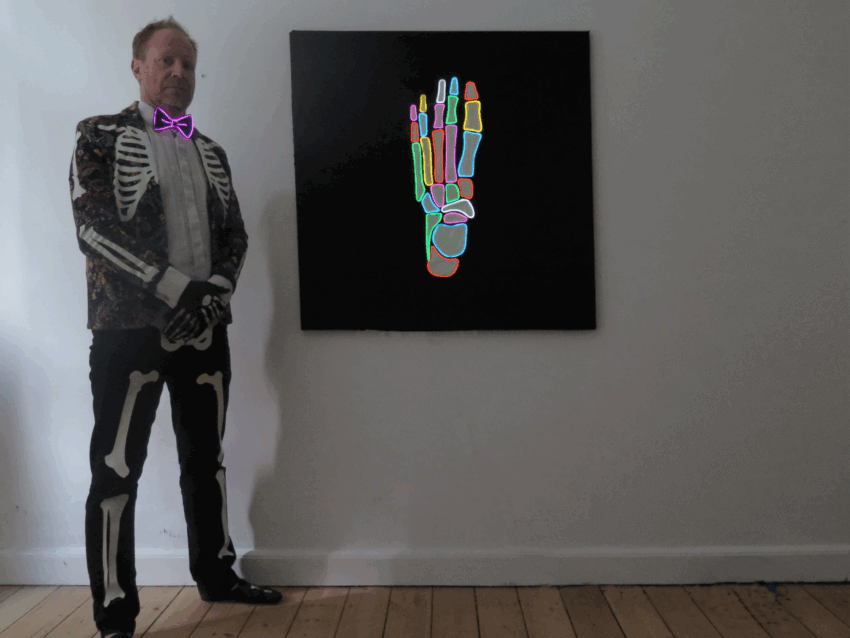
Phosporescent bones and EL Wire on black canvas
Skeleton-Man is carried and performed by Michael Wolffhechel (b. 1969) – artist, performer, and former lawyer with a background in philosophy, therapy, and organizational thinking.
The entire process from idea and materials to performance and staging is carried out personally. This creates a high degree of authenticity, flexibility, and adaptation to the specific context.
Skeleton-Man is not a concept that can be copied.
It is a living practice that adapts to spaces, people, and situations.
Who is it relevant for?
Skeleton-Man is relevant for:
- companies and organizations undergoing change
- consultancies and advisors working with leadership, culture, and working life
- leadership groups and teams seeking to strengthen reflection, courage, and shared responsibility
- educational and learning environments focusing on the human aspects of work
Read more
- [Download Master Presentation “Skeleton-Man – A Performative Art Practice“]
- [Download Art and Curatorial Presentation]
For dialogue regarding possibilities, formats, booking and customization:
📩 info@skeleton-man.com